⚡ Quick Summary
- For most Indian salaried professionals: do both — prepay AND invest in SIP, in the right proportion
- Your effective home loan rate after Section 24(b) is 5.5–7%, not 8.5% — this changes the math entirely
- The answer is different under old tax regime vs new tax regime
- There is a specific rupee amount you can prepay each FY without losing ₹60,000 in tax benefit
- PrepayPlanner calculates this limit automatically — FY by FY, for your exact loan
In This Article
Every April, when appraisal bonuses land in bank accounts, the same question surfaces in offices across Mumbai, Bangalore, Delhi, Hyderabad, Chennai, and Pune:
"Should I prepay my home loan or start a SIP?"
Most financial content gives you a generic framework. This article gives you the actual answer — based on the one variable almost nobody accounts for: your effective home loan rate after Section 24(b) tax deduction.
The Number That Changes Everything
Your home loan interest rate is not really 8.5%.
If you are on the old tax regime and claim the full Section 24(b) deduction of ₹2 lakhs per year, your effective after-tax home loan cost is considerably lower. Here is the exact calculation for a salaried professional in the 30% tax bracket with a ₹50 lakh outstanding loan at 8.5%:
| Item | Amount |
|---|---|
| Annual interest paid on ₹50L outstanding | ₹4,25,000 |
| Section 24(b) deduction allowed (max) | ₹2,00,000 |
| Tax saved at 30% slab on ₹2L deduction | ₹60,000 |
| Effective interest paid after tax | ₹3,65,000 |
| Effective rate on ₹50L loan | 7.3% — not 8.5% |
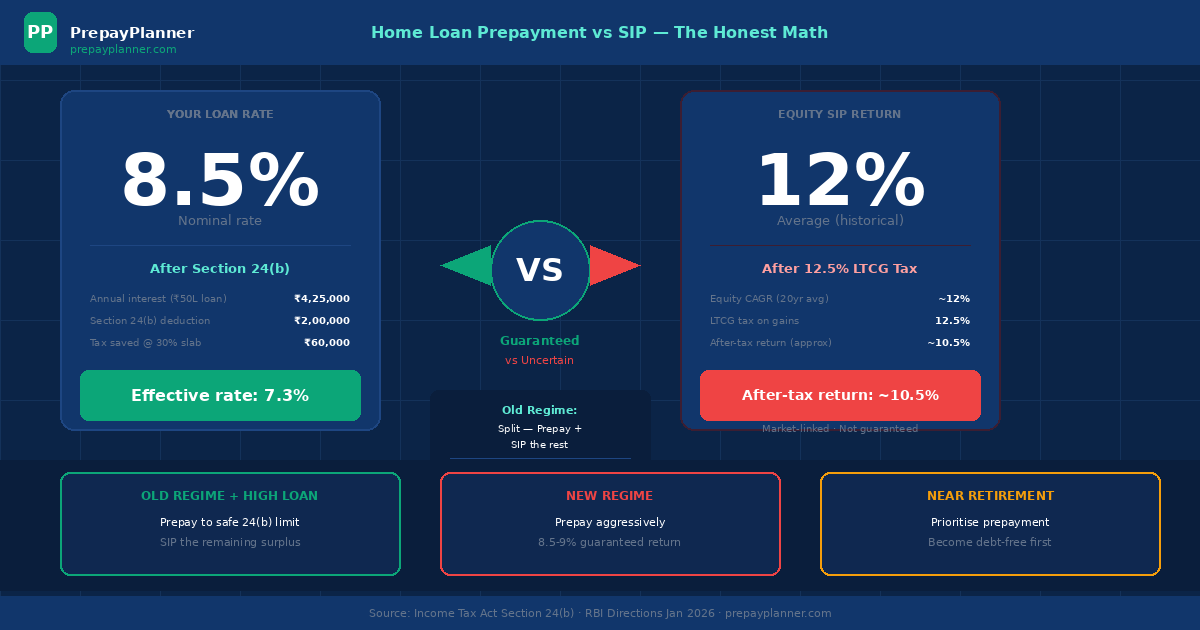
At 7.3% effective cost, and with equity SIPs returning approximately 10.5% after 12.5% LTCG tax over the long run, the SIP wins mathematically — by a margin of roughly 3%.
But this calculation assumes you can claim the full ₹2 lakh Section 24(b) deduction. And here is where most people make a costly mistake.
The Mistake That Costs ₹60,000 Per Year
As you prepay your home loan, your outstanding principal reduces. Lower principal means lower annual interest. At some point, your annual interest drops below ₹2 lakhs — the Section 24(b) cap. When that happens, you lose your full tax deduction.
For a borrower in the 30% tax bracket, this means losing ₹60,000 in annual tax savings — every year, for the remaining loan tenure.
There is a specific rupee amount you can prepay each financial year before this happens. It is called the safe prepayment limit. Most home loan calculators do not tell you this number. Your bank certainly does not calculate it for you. PrepayPlanner does — automatically, FY by FY, based on your exact loan balance and interest rate.
The 2026 Rule Change That Makes Prepayment More Attractive
Under revised RBI Directions (July 2, 2025): banks cannot levy prepayment charges on loans to individuals for non-business purposes, irrespective of source of funds and without any minimum lock-in period. Zero penalty. Zero lock-in. Prepay any amount, any time.
This makes the case for prepayment stronger than it has ever been. There is no longer any cost barrier to making a lump sum payment whenever you have surplus funds — a bonus in April, a maturity from an FD, or a Diwali gift.
The Answer by Tax Regime
| Tax Regime | Effective Home Loan Rate | Best Strategy |
|---|---|---|
| Old Tax Regime (claiming Section 24b) | 5.5–7.3% effective | Split: prepay up to safe limit, SIP the rest |
| New Tax Regime (Section 24b not available) | Full 8.5–9% nominal | Prepay more aggressively — guaranteed return vs uncertain SIP |
Important: The new tax regime became the default from AY 2024-25. As per the Income Tax Department, If you have not actively chosen the old regime during ITR filing, you may already be on the new regime — and may not be claiming the Section 24(b) deduction you think you are.
The City-Specific Reality
The right answer also depends on where you live and what your loan looks like.
Mumbai and Thane: Average home loan sizes of ₹80–₹1.2 crore mean annual interest well above the ₹2 lakh cap for most of the loan tenure. The safe prepayment limit is often ₹3–₹5 lakhs per FY. Prepayment is very tax-efficient for high-value Mumbai loans.
Bangalore and Hyderabad: IT professionals receiving annual bonuses of ₹3–₹8 lakhs face the exact safe limit question every April. A ₹60L outstanding loan at year 8 has a very different safe limit than a ₹40L outstanding loan at year 14.
Delhi NCR and Gurgaon: MNC employees with step-up income often see loans reduce rapidly. The Section 24(b) cap becomes relevant sooner — making early calculation critical before each April bonus decision.
Chennai: Indian Bank is headquartered here, and PrepayPlanner comes pre-loaded with Indian Bank's rate history. Tamil Nadu salaried professionals on old tax regime benefit most from the safe limit calculation.
Pune: Younger IT professionals (28–35) taking their first home loan face the longest remaining tenure — making the "prepay early for maximum impact" argument strongest here. The first 7 years of any home loan are the highest-impact prepayment window.
The Framework — What to Actually Do
See your exact savings — free
PrepayPlanner shows your interest savings estimate instantly. The full Excel tool gives you your FY-wise safe prepayment limit, Section 24(b) tax analysis, and 30-year amortization schedule. One-time purchase. Works offline. Your data never leaves your laptop.
Try Free Calculator → See Plans from ₹199Frequently Asked Questions
Is prepayment better than SIP for a home loan in India?
For most salaried borrowers on old tax regime, a split approach works best — prepay up to the Section 24(b) safe limit each FY (protecting your ₹60,000 tax benefit), and invest the remaining surplus in equity SIP. On the new tax regime, prepayment is more attractive since the Section 24(b) deduction is unavailable for self-occupied properties.
What is the Section 24(b) safe prepayment limit?
The safe prepayment limit is the maximum amount you can prepay in a financial year before your annual home loan interest drops below the ₹2 lakh Section 24(b) deduction cap. Crossing this limit means losing ₹60,000 per year in tax savings. The limit varies by loan balance and interest rate, and changes each FY. PrepayPlanner calculates it automatically for your loan.
Are there prepayment charges on home loans in India in 2026?
No. As per RBI Directions effective January 1, 2026, banks cannot charge prepayment penalties on floating-rate home loans taken by individuals for non-business purposes, irrespective of the source of funds or any lock-in period. This applies to all major banks including HDFC, SBI, ICICI, Axis, Indian Bank, and Kotak.
Which is better — reducing EMI or reducing tenure when prepaying?
Reducing tenure saves significantly more total interest. When you prepay and reduce tenure, your EMI stays the same but the loan closes earlier — eliminating months of future interest charges. Reducing EMI provides monthly cash flow relief but saves considerably less overall. Always choose tenure reduction unless monthly cash flow is a genuine constraint.
How do I calculate my effective home loan rate after tax?
Effective rate = (Total annual interest − Tax saved on Section 24(b) deduction) ÷ Outstanding loan balance. Example: ₹50L loan at 8.5% with full ₹2L deduction at 30% slab → Effective rate = (₹4.25L − ₹0.60L) ÷ ₹50L = 7.3%. PrepayPlanner shows this calculation in the Tax Savings sheet.
Should I prepay my home loan if I am on the new tax regime?
Yes — more aggressively than under old regime. Since Section 24(b) deduction is not available on self-occupied property under the new regime, your home loan costs exactly the nominal rate (8.5–9%). At this rate, prepayment offers a guaranteed return that is competitive with market-linked equity SIP returns, with zero risk of loss.
This article is for educational purposes only. Consult a Chartered Accountant for personalised tax advice specific to your situation.