⚡ Quick Summary
- Section 24(b) caps your home loan interest tax deduction at ₹2 lakh per year (self-occupied property, old regime)
- As you prepay, your outstanding principal falls — and so does your annual interest
- Once annual interest drops below ₹2 lakh, you start losing tax benefit on the shortfall
- There is an exact rupee amount you can prepay each FY before this happens — the safe prepayment limit
- This limit shrinks every year as your loan balance reduces — it must be recalculated annually
- PrepayPlanner calculates this automatically, FY by FY, for your exact loan
In This Article
Every home loan borrower on the old tax regime knows about Section 24(b) — the ₹2 lakh deduction on home loan interest. Fewer know that aggressive prepayment can quietly shrink this benefit, without any warning from their bank.
Prepay too much, too fast, and you can lose up to ₹60,000 a year in tax savings — even while genuinely reducing your total interest cost. This article shows you the exact number where that trade-off happens, and how to plan around it.
The ₹2 Lakh Cap, Explained
Under Section 24(b) of the Income Tax Act, a self-occupied property owner on the old tax regime can deduct up to ₹2,00,000 of home loan interest paid in a financial year from their taxable income. For a borrower in the 30% tax bracket, that deduction is worth exactly ₹60,000 in actual tax saved.
This cap is fixed — it does not scale with your loan size. A ₹40L loan and a ₹1.5Cr loan both get the same ₹2 lakh ceiling. What changes, over time, is how much of your actual interest falls within that ceiling.
The Exact Formula
Your annual interest is a function of your outstanding principal and your rate. As you prepay, principal drops — and so does interest, month over month. The safe prepayment limit is the amount you can remove from principal before your annual interest for the year falls below ₹2 lakh.
| Step | Calculation |
|---|---|
| Principal level where interest = ₹2L cap exactly | ₹2,00,000 ÷ annual rate |
| Your current outstanding principal | From your latest statement |
| Approximate safe limit this FY | Current outstanding − cap-level principal |
This is a simplified, whole-year approximation. Because EMIs are paid monthly and interest recalculates monthly on a reducing balance, the precise safe limit for a specific financial year requires running your actual amortization schedule month by month — which is exactly what a proper prepayment calculator should do, rather than a single static formula.
A Worked Example, Year by Year
Consider a ₹60 lakh home loan at 8.5%, taken at the start of the financial year.
| Loan Year | Outstanding Principal | Annual Interest (no prepay) | Approx. Safe Limit This FY |
|---|---|---|---|
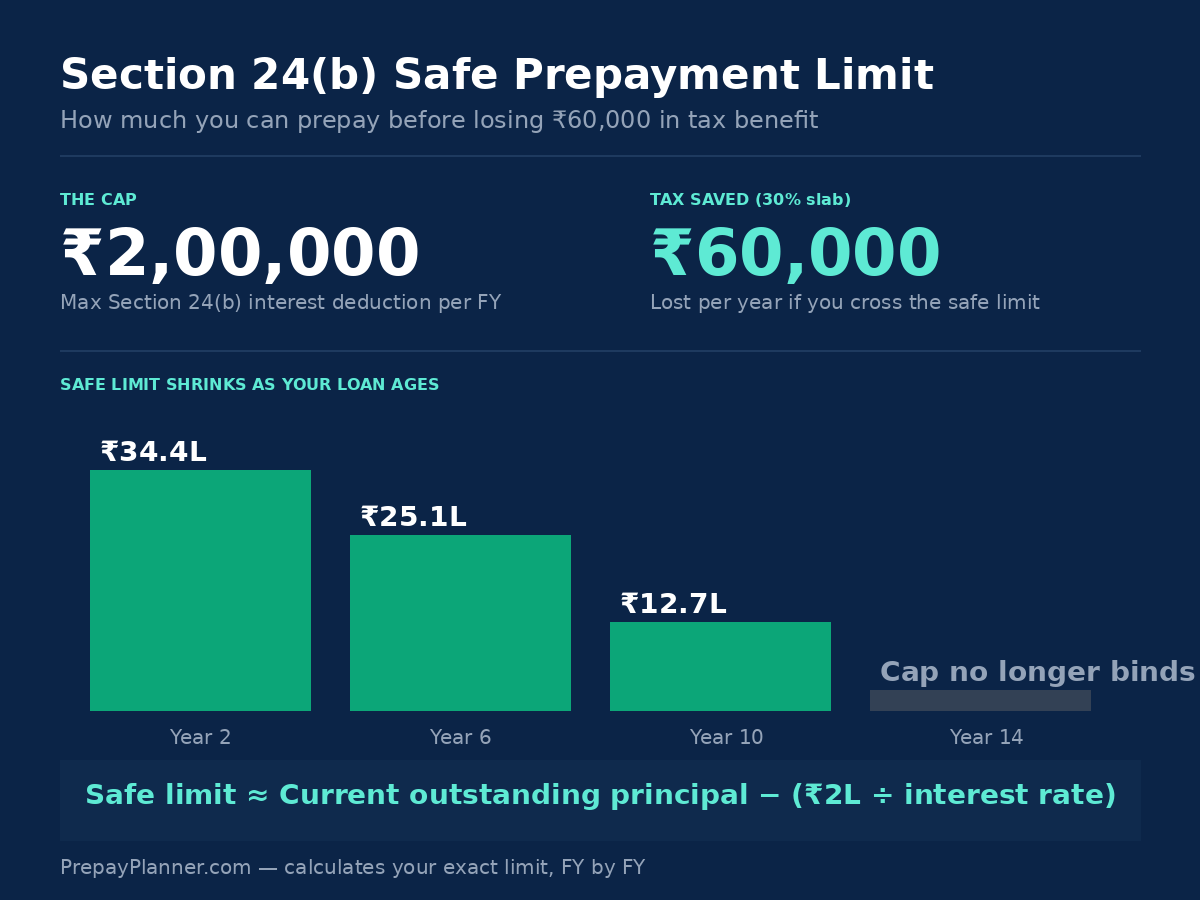
| Year 2 | ₹57.8L | ₹4.85L | ₹34.4L (interest well above cap) |
| Year 6 | ₹48.6L | ₹4.05L | ₹25.1L |
| Year 10 | ₹36.2L | ₹2.98L | ₹12.7L |
| Year 14 | ₹19.8L | ₹1.58L | Already below cap — full prepayment is tax-safe |
Notice how the safe limit shrinks steadily as the loan ages. In the early years, there is enormous room to prepay before the cap becomes a concern at all. By year 14 in this example, annual interest has already fallen below ₹2 lakh on its own — at that point, the Section 24(b) consideration disappears entirely, and every rupee of prepayment saves interest with no tax trade-off.
The Common Mistake
The mistake is not prepaying too much — it is prepaying without checking the number first. A borrower who receives a large bonus and prepays the entire amount in one go, without checking where their safe limit sits that year, can easily cross it by several lakhs — giving up real tax savings for a marginal extra reduction in interest that could have waited until the following FY.
This does not mean you should always stop exactly at the safe limit. Sometimes the extra interest saved by prepaying beyond it is still worth more than the ₹60,000 tax benefit lost — particularly on very large loans in the early years. The point is to make that decision knowingly, not by accident.
City-Specific Safe Limits
Because the safe limit depends entirely on loan size and loan age, it varies significantly by city and borrower profile.
Mumbai and Thane: With average loan sizes of ₹80L–₹1.2Cr, annual interest stays above the ₹2L cap for most of the loan tenure. Safe limits here are often ₹3–5L per FY even well into the loan's life — meaning the Section 24(b) ceiling remains relevant for longer.
Bangalore and Hyderabad: IT professionals with ₹50–70L loans typically see their safe limit shrink meaningfully by years 8–10, right as annual bonuses tend to be largest — making the calculation most valuable exactly when the temptation to prepay big is highest.
Delhi NCR and Gurgaon: Step-up salaries often mean faster-than-average prior prepayment, which brings the safe limit question forward — sometimes becoming relevant as early as year 5–6.
Chennai: Indian Bank's rate structure, built into PrepayPlanner, gives Chennai borrowers on the old regime a precise, bank-matched safe limit calculation rather than a generic estimate.
Pune: Younger first-time borrowers (28–35) with 20-year tenures have the most runway — safe limits stay large for many years, giving the most flexibility for aggressive early prepayment without tax consequence.
The 2026 RBI Rule Change
Under revised RBI Directions (July 2, 2025): banks cannot levy prepayment charges on loans to individuals for non-business purposes, irrespective of source of funds and without any minimum lock-in period. Zero penalty. Zero lock-in.
This makes calculating your safe limit even more important, not less. With no financial penalty standing in the way of prepaying any amount, the only real constraint left is the tax trade-off itself — which makes knowing your exact number the single most useful piece of planning you can do before making a lump sum payment.
See your exact safe limit — free
PrepayPlanner's free calculator shows your interest savings instantly. The full Excel tool calculates your FY-wise Section 24(b) safe prepayment limit automatically, alongside your complete 30-year amortization schedule. One-time purchase. Works offline. Your data never leaves your laptop.
Try Free Calculator → See Pricing from ₹199Frequently Asked Questions
What exactly is the Section 24(b) safe prepayment limit?
It is the maximum amount you can prepay in a financial year before your annual home loan interest drops below the ₹2 lakh Section 24(b) deduction cap. Prepay beyond this limit and you start losing tax benefit on the excess, even though you are still saving on interest.
How do I calculate my own safe prepayment limit?
Find the outstanding principal at which your annual interest equals exactly ₹2 lakh (principal = ₹2,00,000 ÷ your interest rate). The difference between your current outstanding and that figure is roughly your safe prepayment limit for the year, though the exact number requires month-by-month amortization since interest recalculates monthly.
What happens if I prepay more than the safe limit?
You do not lose money overall — you still save on interest. But you lose the tax deduction on the portion of interest below ₹2 lakh, which for a 30% tax bracket borrower means losing up to ₹60,000 in tax savings for that financial year. Whether this trade-off is worth it depends on your tax regime and how much surplus you have.
Does the safe limit change every year?
Yes. As your outstanding principal reduces (through EMIs and prior prepayments), your annual interest naturally decreases too, which means the safe limit shrinks every financial year. A limit calculated in year 3 of your loan will be different, usually smaller, by year 8.
Is the safe limit relevant if I am on the new tax regime?
No. Section 24(b) deduction on a self-occupied property is not available under the new tax regime, so there is no cap to protect. New regime borrowers can prepay as aggressively as their surplus allows without this specific consideration.
Do banks or loan apps calculate this safe limit for me?
No major bank or generic EMI calculator app currently surfaces this figure. It requires combining your amortization schedule with the Section 24(b) tax rule, recalculated for your exact outstanding balance and rate. PrepayPlanner calculates it automatically, financial year by financial year.
This article is for educational purposes only. Consult a Chartered Accountant for personalised tax advice specific to your situation.