⚡ Quick Summary
- Home loans use reducing-balance interest — the same rupee prepaid earlier saves far more than prepaid later
- The first 6-7 years of a 20-year loan carry the highest prepayment leverage
- The same lump sum prepaid in year 2 vs year 10 can save 2-3x more total interest
- Bonus season (April/October) lands right inside this high-impact window for most salaried borrowers
- Prepaying later is still worthwhile — just proportionally less powerful per rupee
- PrepayPlanner shows you exactly how much any prepayment saves, at your current loan year
In This Article
Every rupee you prepay saves interest. But not every rupee saves the same amount of interest — and the difference comes down entirely to timing, not the amount itself.
A ₹5 lakh prepayment in year 2 of your loan can save nearly three times more total interest than the exact same ₹5 lakh prepaid in year 12. This article explains why, with the real math, and tells you exactly what to do whether you're in year 1 or year 15 of your loan.
Why Timing Changes Everything
Indian home loans use reducing-balance interest — interest is calculated fresh each month on whatever principal is still outstanding, not on the original loan amount. This single mechanical fact is the entire reason timing matters so much.
Early in a loan, your outstanding principal is at its highest — so it's also generating the most interest, every single month, for the longest remaining stretch of time. When you prepay early, you're eliminating interest on that money for potentially 15-18 more years. Prepay the same amount in year 15, and you're only eliminating interest for the 3-5 years left.
The Amortization Math, Simply Explained
Think of it this way: prepaying ₹1 lakh doesn't just save you the interest on that ₹1 lakh for one year — it saves you interest on that ₹1 lakh for every single remaining year of your loan, because that ₹1 lakh would have continued generating interest, year after year, if left in the loan.
| Prepay in Year | Remaining Tenure | Years of Interest Avoided |
|---|---|---|
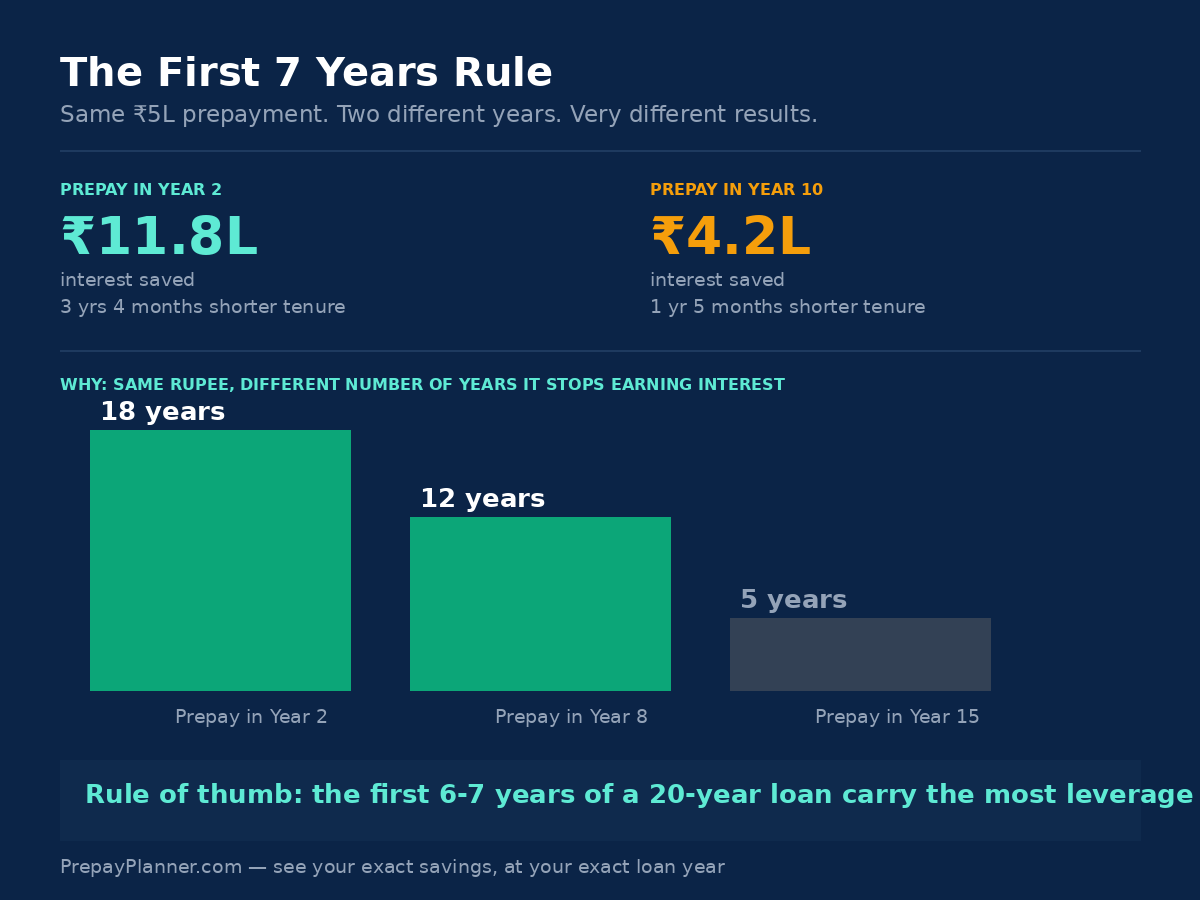
| Year 2 | 18 years left (20yr loan) | Interest avoided for ~18 years |
| Year 8 | 12 years left | Interest avoided for ~12 years |
| Year 15 | 5 years left | Interest avoided for ~5 years |
The same rupee, the same prepayment amount — but the number of years it stops generating interest for is completely different depending on when you act. This is the entire first-7-years rule in one table.
Same ₹5L, Two Different Years
Consider a ₹60 lakh home loan at 8.5% over 20 years.
| Scenario | Prepayment | Total Interest Saved | Tenure Reduction |
|---|---|---|---|
| Prepay in Year 2 | ₹5,00,000 | ₹11.8L | 3 years 4 months |
| Prepay in Year 10 | ₹5,00,000 | ₹4.2L | 1 year 5 months |
Same amount. Same borrower. Same interest rate. The only difference is when — and it results in nearly 2.8x more interest saved and more than double the tenure reduction, purely from acting 8 years earlier.
This is why "I'll prepay once I have more savings" is often the wrong instinct. A smaller prepayment made early frequently outperforms a larger prepayment made late. Timing, not just amount, is a real lever — one most borrowers never realize they're pulling.
Why Bonus Season Timing Matters
For most salaried Indian professionals, annual bonuses land in April or October — and for many borrowers, this timing happens to fall squarely within their loan's first 7-year high-impact window, simply because most home loans are taken relatively early in a career.
This is a genuine, useful coincidence: the money you're most likely to have available for a lump-sum prepayment (your bonus) tends to arrive during exactly the years when prepaying it does the most good. Directing bonus income toward prepayment, rather than other discretionary spending, captures both the cash-flow convenience and the timing advantage at once.
One caveat if you're on the old tax regime: check your Section 24(b) safe prepayment limit before committing your full bonus — prepaying beyond it can cost you up to ₹60,000 in lost tax deduction for that financial year. (See our full guide to the safe limit for the exact calculation.)
What If You're Already Past Year 7?
Prepaying is still genuinely worthwhile — this rule identifies the highest-impact window, not the only window with any impact at all. Every year you wait does reduce the remaining leverage, but the honest, simple answer for someone in year 10, 12, or even 15 of their loan is the same: the best time to prepay is now, not later, since tomorrow's remaining tenure will always be shorter than today's.
Under revised RBI Directions (July 2, 2025): banks cannot levy prepayment charges on loans to individuals for non-business purposes, irrespective of loan age or source of funds. This applies whether you're in year 1 or year 18 of your loan.
City-Specific Timing Notes
Bangalore and Hyderabad: IT professionals typically receive bonuses of ₹3-8 lakhs annually. A borrower 3-5 years into their loan, receiving this bonus, sits right in the highest-leverage window — this is the single most common, highest-impact prepayment scenario in these cities.
Pune: Younger first-time buyers (28-35) taking 20-year loans have the longest remaining tenure of any major metro — making the first-7-years argument strongest here. A Pune borrower in year 2 has more leverage-per-rupee than almost anyone else in this analysis.
Mumbai and Thane: Larger average loan sizes (₹80L-1.2Cr) mean the absolute rupee impact of early prepayment is proportionally larger too — the same percentage-based logic applies, just at bigger numbers.
Chennai: A more conservative, tax-conscious borrower base tends to prepay steadily rather than in large lump sums — the first-7-years rule still applies to each individual prepayment made, regardless of size.
Delhi NCR and Gurgaon: Step-up salary structures common in MNC roles often mean rapid income growth in years 2-5 — exactly when the prepayment window is most powerful, making early aggressive prepayment particularly effective here.
See your own numbers, at your exact loan year
PrepayPlanner's free calculator shows your real interest savings instantly. The full Excel tool models your complete 30-year amortization schedule, showing exactly how much any prepayment saves at any point in your loan. One-time purchase. Works offline. Your data never leaves your laptop.
Try Free Calculator → See Pricing from ₹199Frequently Asked Questions
Why are the first 7 years the best time to prepay a home loan?
In a reducing-balance loan, interest is calculated on the outstanding principal every month. Early in the loan, the outstanding principal is at its highest, so every rupee you prepay eliminates interest on that rupee for the maximum remaining number of months. The same rupee prepaid in year 15 only saves interest for the few years left, making it worth far less.
Does this mean prepaying later is a waste of money?
No — prepaying later still saves real interest and is never a bad decision. It simply saves proportionally less per rupee than the same amount prepaid earlier, because there is less remaining loan life for that rupee to have avoided interest on.
How much difference does timing actually make in rupees?
On a typical Indian home loan, the same lump sum prepaid in year 2 instead of year 10 can save two to three times more total interest, because it compounds its effect over a much longer remaining tenure.
Should I prepay with my annual bonus every year?
For most salaried borrowers in the first 7 years of their loan, yes — directing bonus income toward prepayment in the early years captures the highest-impact window. This should be balanced against the Section 24(b) safe prepayment limit if you are on the old tax regime.
What if I am already past year 7 of my loan?
Prepaying is still worthwhile — you have simply moved past the single highest-impact window, not out of all benefit. The next-best time to prepay is always now, since every year of delay reduces the remaining interest-saving potential further.
Does the first-7-years rule apply to all loan tenures?
The exact number of high-impact years scales with your loan tenure — roughly the first third of a 20 to 30-year loan carries the most prepayment leverage. For a 20-year loan this window is closer to the first 6-7 years; for a 30-year loan it extends slightly further.
This article is for educational purposes only. Consult a Chartered Accountant or financial advisor for advice specific to your situation.