⚡ Quick Summary
- When you prepay, your bank asks: reduce the EMI, or reduce the tenure?
- Reducing tenure saves significantly more total interest — same EMI, loan closes years earlier
- Reducing EMI helps monthly cash flow, but saves far less overall
- The exception: genuine cash-flow constraints, where lower EMI matters more than maximum savings
- Most banks default to reducing EMI unless you specifically ask for tenure reduction
- PrepayPlanner shows both outcomes side by side with your real numbers
In This Article
Every time you make a lump-sum prepayment, your bank gives you a choice that rarely gets explained clearly: reduce your EMI, or reduce your tenure. Most borrowers pick without realizing one option saves dramatically more money than the other — sometimes lakhs more, over the life of the loan.
Why One Option Saves More — The Mechanism
Reduce Tenure: Your EMI stays exactly the same. But because you've reduced the principal, the loan now finishes earlier than originally scheduled — eliminating months (sometimes years) of future interest entirely.
Reduce EMI: Your monthly payment drops. But the loan still runs for its original full term — you keep paying interest every single month for the same number of months as before, just a smaller amount each time.
The core insight: interest is charged for as long as the loan exists. Shortening the loan's LIFESPAN (tenure reduction) eliminates entire months of interest charges. Shrinking the monthly PAYMENT (EMI reduction) doesn't shorten that lifespan at all — you're still paying interest for the same number of months, just less of it each time.
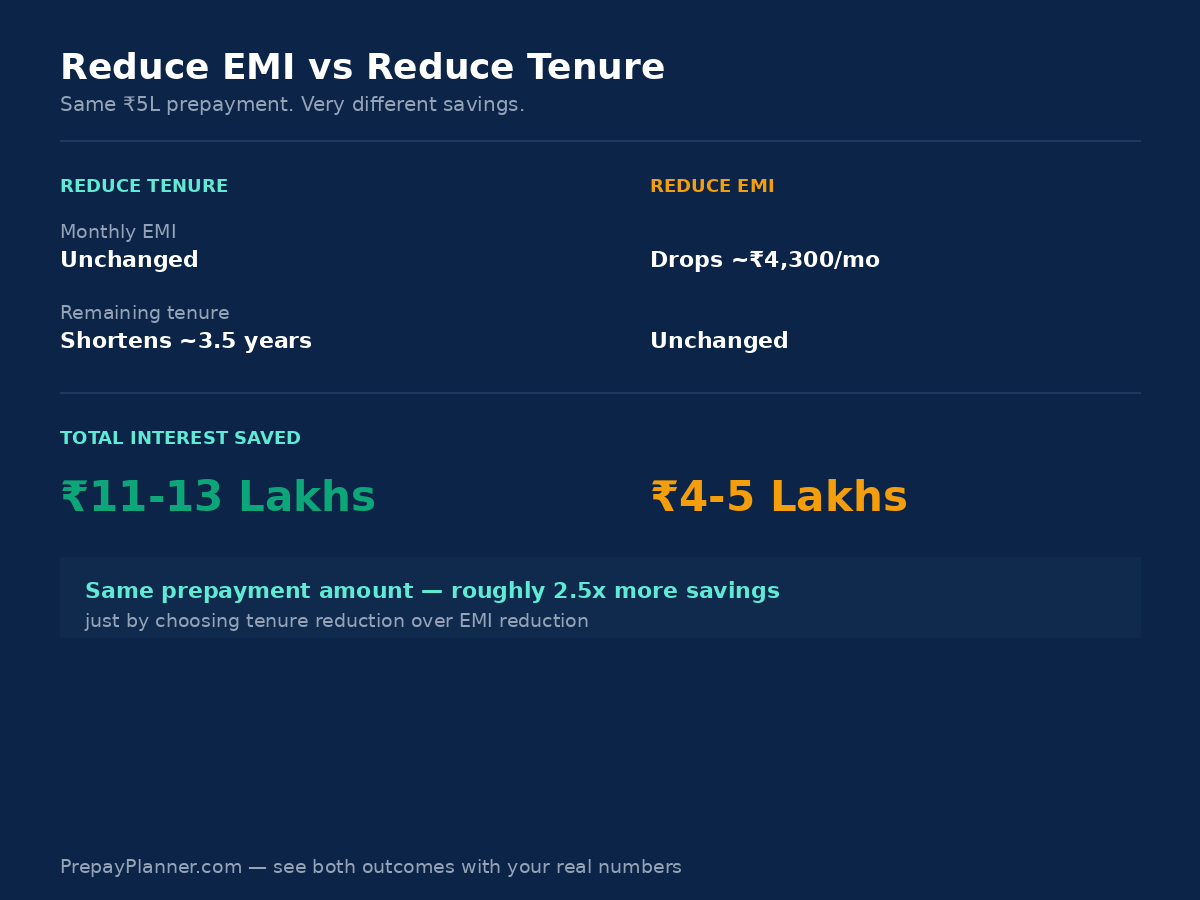
A Worked Example, Side by Side
Deepa, a finance analyst with a ₹50 lakh loan at 8.5% over 20 years, prepaid ₹5 lakh in year 3 and had to choose between the two options.
| Reduce Tenure | Reduce EMI | |
|---|---|---|
| Monthly EMI | Unchanged — same as before | Drops by ~₹4,640/month |
| Remaining tenure | Shortens by 3.4 years | Unchanged — full remaining term |
| Total interest saved | ₹13.2 lakh | ₹4.5 lakh |
Same ₹5 lakh prepayment, roughly 2.9x more total savings simply by choosing tenure reduction over EMI reduction. This isn't unique to Deepa's specific numbers — this pattern holds broadly across loan sizes and tenures: tenure reduction consistently delivers somewhere between 20% and 40% more total interest savings than EMI reduction for an identical prepayment amount, with the exact multiple depending on your rate and how early in the loan you prepay. The prepayment amount doesn't change — only which lever you pull changes how much of that prepayment's potential gets captured.
Why Banks Often Default to Lower EMI
Many banks' default process — especially for online or app-based prepayments — automatically reduces the EMI unless you explicitly request tenure reduction instead. This isn't necessarily deceptive; a lower EMI is an easier, more universally welcome outcome to present to any customer, regardless of their actual financial goals.
Under revised RBI Directions (July 2, 2025): banks cannot charge prepayment penalties on individual home loans, regardless of funding source, with no minimum lock-in period. This makes prepaying more attractive than ever — but the EMI-vs-tenure choice still needs to be made deliberately, since this rule doesn't change which option a bank defaults to.
The practical takeaway: always explicitly ask your bank (or select, in their app/portal) to reduce tenure, not EMI — unless you have a specific, genuine reason to prefer the alternative (see below).
When Lower EMI Is the Right Choice
Tenure reduction isn't universally correct — it's correct when maximizing total savings is the goal. There's one legitimate exception:
Outside these specific situations, tenure reduction is almost always the better default — it captures more of your prepayment's value without requiring any extra cash flow discipline going forward.
City-Specific Notes
Bangalore: IT professionals prepaying from April/October bonuses face this exact choice repeatedly across the loan's life — worth deciding on tenure reduction as a standing preference, not re-deciding each time.
Pune: Younger borrowers (28-35) with the longest remaining tenure have the most to gain from tenure reduction specifically — reducing a 20-year loan to 12-14 years captures the maximum possible benefit from early, consistent tenure-reduction prepayments.
Mumbai: With larger average loan sizes (₹80L-1.2Cr), the absolute rupee difference between tenure and EMI reduction is proportionally larger — the same 2.5x multiplier applies to a bigger base number.
Chennai: A detail-oriented, conservative borrower base — worth explicitly confirming with your lender (Indian Bank and others) which option is being applied by default before assuming.
Delhi NCR and Gurgaon: MNC employees with step-up incomes rarely face genuine cash-flow constraints as tenure progresses — tenure reduction is almost always the stronger default choice here specifically.
See both outcomes with your real numbers
PrepayPlanner's free calculator shows your prepayment savings instantly. The full Excel tool models both tenure-reduction and EMI-reduction outcomes side by side — so you can see the real rupee difference for your specific loan, not a generic example. One-time purchase. Works offline.
Try Free Calculator → See Pricing from ₹199Frequently Asked Questions
Which is better — reducing EMI or reducing tenure when prepaying?
Reducing tenure saves significantly more total interest. When you prepay and reduce tenure, your EMI stays the same but the loan closes earlier, eliminating months of future interest. Reducing EMI provides monthly cash flow relief but saves less overall. Always choose tenure reduction unless cash flow is a genuine constraint.
Why do banks often default to reducing EMI instead of tenure?
A lower EMI is a simpler, more universally welcome outcome to present by default, especially through automated online prepayment portals. It isn't necessarily deceptive, but it does mean borrowers must actively choose tenure reduction rather than assume it happens automatically.
How much more can tenure reduction save compared to EMI reduction?
The exact multiplier depends on your loan's remaining tenure and interest rate, but it's common to see tenure reduction save roughly 2-3 times more total interest than EMI reduction for the same prepayment amount, especially earlier in a loan's life.
Is there ever a good reason to choose lower EMI instead?
Yes — if you have a genuine cash-flow constraint, or you're approaching a period of reduced income (such as retirement), the immediate relief of a lower monthly payment can be worth more to you personally than maximizing total interest savings.
Can I choose tenure reduction even if my bank's app defaults to EMI reduction?
In most cases yes — many banks allow you to explicitly select tenure reduction instead, either through their app, net banking portal, or by requesting it directly at a branch. Always check before assuming the default option is what you actually want.
This article is for educational purposes only. Consult a financial advisor or your lender directly for advice specific to your situation.