⚡ Quick Summary
- Section 24(b) home loan interest deduction (₹2L cap) exists ONLY under the old regime, for self-occupied property
- New regime has zero Section 24(b) benefit on a self-occupied home — none at all
- The real decision threshold: total deductions above ~₹3.5-4.5 lakh generally favor old regime
- New regime FY 2025-26: standard deduction ₹75,000, income up to ₹12.75L effectively tax-free (salaried)
- Old regime FY 2025-26: standard deduction ₹50,000, but stacks with 80C (₹1.5L) + Section 24(b) (₹2L)
- This threshold shifts every year as you prepay — PrepayPlanner's built-in regime toggle recalculates it automatically
In This Article
For most Indian taxpayers, the old-vs-new regime choice is a fairly generic exercise — add up deductions, compare against slabs, pick the lower number. For someone with a home loan on a self-occupied property, it isn't generic at all. One specific deduction — Section 24(b) — exists in ONE regime and is completely absent in the other, and it's often large enough to flip the entire decision on its own.
The One Difference That Matters Most
Under the old regime, self-occupied property owners can deduct up to ₹2,00,000 of home loan interest annually under Section 24(b) — combinable with ₹1,50,000 of principal repayment under Section 80C.
Under the new regime, this deduction does not exist for a self-occupied home. Not capped, not reduced — simply unavailable. (For a let-out/rented property, both regimes actually allow full interest deduction with no upper limit — but the new regime restricts setting off any resulting loss against your salary income, capping it at ₹2 lakh and carrying the rest forward instead.)
This single difference is why many home loan holders — who would otherwise benefit from the new regime's lower slabs — still choose the old regime. The math genuinely depends on how large your other deductions are alongside it.
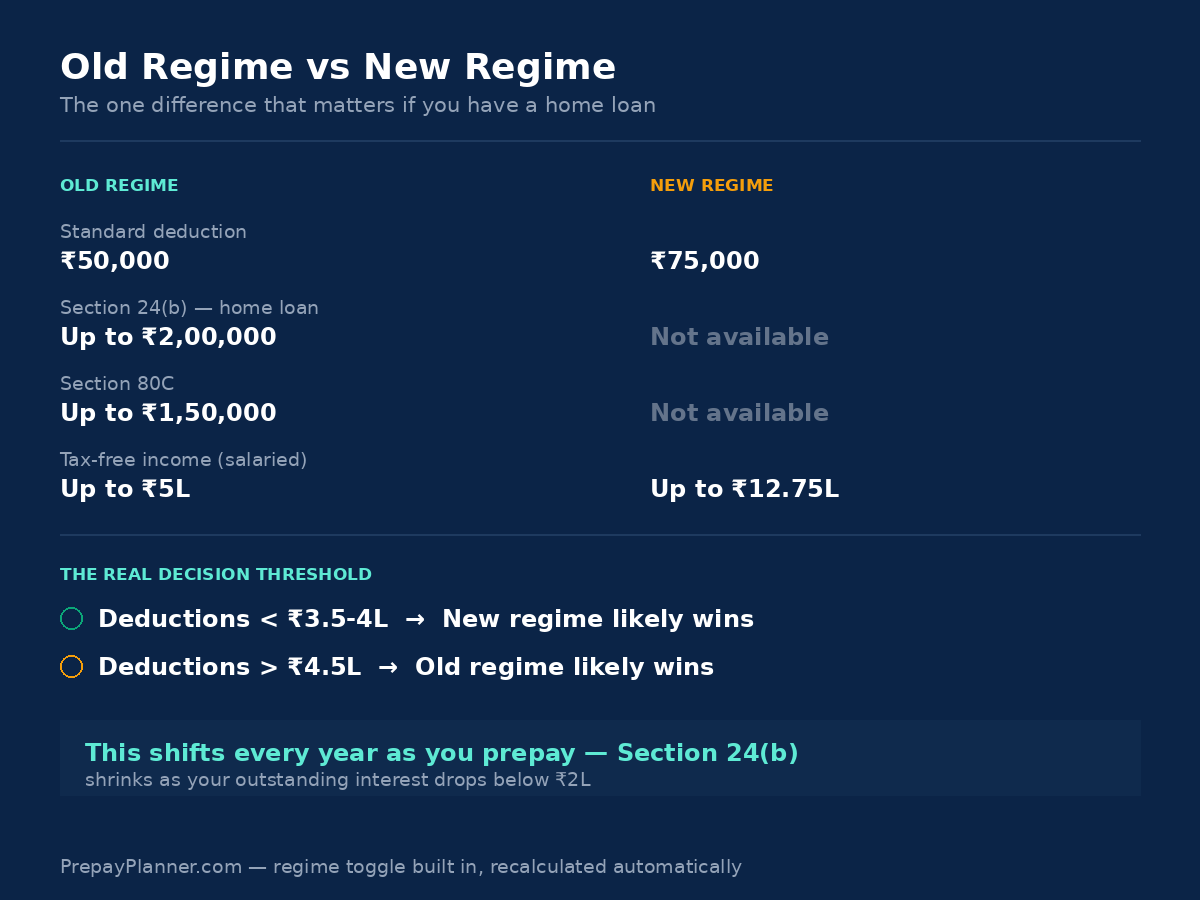
FY 2025-26 Numbers, Side by Side
| Old Regime | New Regime | |
|---|---|---|
| Standard deduction | ₹50,000 | ₹75,000 |
| Section 24(b) — self-occupied home | Up to ₹2,00,000 | Not available |
| Section 80C (principal, PPF, ELSS, etc.) | Up to ₹1,50,000 | Not available |
| Tax-free income (salaried, with rebate) | Up to ₹5L (87A rebate) | Up to ₹12.75L |
| Slab rates | Higher, unchanged | Lower, 7 slabs to 30% |
Notice the shape of the trade-off: new regime wins decisively on slab rates and the rebate threshold — but old regime can claw back significant ground specifically through the ₹2L + ₹1.5L combination that only exists there.
A Worked Example
Salaried individual, ₹12 lakh annual income, ₹50L home loan at 8.5%, mid-loan (interest component still substantial).
| Regime | Deductions Claimed | Approx. Tax Saved vs No Deductions |
|---|---|---|
| Old Regime | ₹2L (24b) + ₹1.5L (80C) + ₹50K (std.) | ~₹70,000 (at 20% marginal rate on the combined ₹3.5L) |
| New Regime | ₹75K (std. deduction only) | No home-loan-linked benefit at all |
In this example, the old regime's home-loan-linked deductions alone are large enough that most borrowers in a similar position come out ahead staying old regime — but this flips as the loan ages and the interest component shrinks (see the section below on why this isn't a one-time decision).
The Real Decision Threshold
Add up ALL your real deductions — standard deduction, 80C, 80D, HRA, home loan interest, NPS — and compare against your income's break-even point.
Why This Answer Changes Every Year
Home loan interest isn't fixed — on a reducing-balance loan, the interest component shrinks every year as principal reduces (the same mechanic behind our First 7 Years Rule article). Early in the loan, annual interest may comfortably exceed the ₹2L Section 24(b) cap — meaning you're using the FULL benefit, and old regime looks strong. Several years in, especially if you've been prepaying, your interest may drop well below ₹2L — meaning old regime's biggest advantage has shrunk too, and new regime may start winning even for the same borrower.
Under revised RBI Directions (July 2, 2025): banks cannot levy prepayment charges on individual home loans, irrespective of source of funds and without any minimum lock-in period. This means you can prepay aggressively — but doing so shrinks your Section 24(b) benefit over time, which is exactly why the regime decision needs revisiting annually, not decided once and forgotten.
This is precisely why a static, one-time regime comparison isn't enough — the right regime for year 2 of your loan may not be the right regime for year 10.
City-Specific Notes
Bangalore: A very common, specific point of confusion among IT professionals here — many assume the new regime's lower slabs are automatically better, without realizing their Section 24(b) claim on a large loan may be worth more than the slab difference.
Delhi NCR and Gurgaon: This is one of the single most-searched, most-confusing topics for salaried professionals in this region specifically — MNC employees with step-up salaries often see their optimal regime shift within just a few years of taking the loan.
Mumbai: With average loan sizes of ₹80L-1.2Cr, the ₹2L Section 24(b) cap is very likely to stay fully utilized for many years — old regime tends to remain favorable longer here than in cities with smaller average loans.
Chennai: A tax-conscious, detail-oriented borrower base — worth explicitly running the numbers each year rather than assuming last year's answer still holds.
Pune: Younger first-time buyers face this exact confusion early, often within their first 2-3 years of home ownership — worth understanding this trade-off from the very start of the loan, not years later.
See which regime wins for YOUR loan — not a generic rule
PrepayPlanner's Pro and 360 tiers include a built-in old-vs-new regime toggle — recalculated automatically as your loan ages and you prepay, so you always know which regime actually saves you more, not just which one did last year. One-time purchase. Works offline. Your data never leaves your laptop.
Try Free Calculator → See Pricing from ₹199Frequently Asked Questions
Is Section 24(b) available under the new tax regime?
No — for a self-occupied property, Section 24(b) interest deduction is not available at all under the new tax regime. It exists only under the old regime, capped at ₹2 lakh per year.
What is the actual threshold for choosing old vs new regime?
As a general guide: total deductions below roughly ₹3.5-4 lakh usually favor the new regime; above roughly ₹4.5 lakh usually favor the old regime. Between those figures, the answer is genuinely close and worth calculating with your exact numbers rather than a rule of thumb.
Can I claim home loan interest deduction on a rented property under the new regime?
Yes — for a let-out (rented) property, both regimes allow full interest deduction with no upper limit. However, the new regime restricts setting off any resulting loss against your salary income, capping the set-off at ₹2 lakh and carrying forward any excess, whereas the old regime allows fuller set-off.
Does prepaying my home loan change which regime is better for me?
Yes — as you prepay, your outstanding principal and annual interest both shrink. Since Section 24(b)'s ₹2 lakh cap is based on actual interest paid, a heavily prepaid loan may generate much less deduction than before, which can shift the optimal regime from old to new over time.
Do I need to choose one regime permanently?
No — salaried individuals can generally switch between regimes each financial year when filing their return. This makes it worth recalculating your position annually, especially as your loan balance and interest component change.
This article reflects FY 2025-26 (AY 2026-27) rules and is for educational purposes only. Tax rules change with each Union Budget — confirm current figures with a Chartered Accountant before filing.